These records are found in the online catalog of The Mariners’ Museum and Park in Newport News, Virginia. Uncurated search results are presented to give researchers and interested readers an idea of whether the museum’s archives contain information about this vessel and whether it may be worthwhile to visit the museum’s catalog search page for further investigation. Uncurated results may be inaccurate or incomplete.
Mariners Museum online catalog search, July 12, 2026. Search phrase: "Stonewall Jackson". Catalog returned 18 records; this selection table includes 18 records fetched through catalog result pages.
Use these buttons to send uncurated search results to your own app or text document for further research. First, check the box for any row, or click "Select All" then uncheck any rows. Then click "Show Selections". You can then copy your selections from the text box and past them into your app.
Written on verso; Jackson, Thomas Jonathan, 1824-1863, General in Confederate States of America
Vignette, head and shoulder portrait, in uniform, from engraving Thomas Jonathan "Stonewall" Jackson Thomas Jonathan Jackson was born on January 21, 1824 in Clarksburg, Virginia. He entered West Point in July 1842 and, in spite of his poor childhood education, worked hard to graduate seventeenth in his class in 1846. Upon graduation, Jackson was sent on military duty to Mexico, and continued his service in the United States Army in positions in New York and Florida. In 1851, Jackson became professor of artillery tactics and natural philosophy at Virginia Military Institute in Lexington, Virginia. He resigned from the army as of February 29, 1852. Jackson's summer vacations from teaching were often spent vacationing in the North and in Europe where his interests were aroused in art and culture rather than military or political aspects. This somewhat calm, domestic period in his life came to a close on April 21, 1861 when he was ordered to go to Richmond as part of the cadet corps. Since military aspirations had faded from his life, he was virtually unknown in this sphere. It was during the Battle of Bull Run in the Civil War when Jackson assumed his nickname. Amidst the tumult of battle, Brigadeer-General Barnard E. Bee stated, "There is Jackson standing like a stone wall." As the war continued, Jackson continually impressed his Confederate compatriots with his skill on the battlefield and in planning conferences. He distinguished himself in the Valley campaign of early 1862, the Battle of second Manassas in August 1862, and the Battle of Fredericksburg in December 1862. Jackson was a Southern hero, and in spite of his eccentricities, he was loved and respected by his soldiers. He strictly observed the Sabbath, and his religiousity was constant in all facets of his life. On May 2, 1863, in his last march of the Civil War, Jackson was wounded by friendly fire. He died of pneumonia several days later on May 10 at Guiney's Station, Virginia. His body was carried to Richmond and then to Lexington where it was buried. It is said that The Army of Northern Virginia never fully recovered from the loss of Stonewall Jackson's leadership in battle. General Robert E. Lee believed Jackson was irreplacable.
A copy print of an engraving done of the painting "The Last Meeting of General Robert E. Lee and Stonewall Jackson at Chancellorsville" by Everett B. D. Julio in 1869. The men are on horses with other soldiers in the background.
INSCRIPTION ON VERSO: BUILT 1861, THE LAST TO BE USED ON THE JAMES RIVERS AND KANAWHA CANAL. THIS BOAT CARRIED THE REMAINS OF STONEWALL JACKSON, FROM LYNCH BURG TO LEXINGTON BURIAL, MAY 1863
INSCRIPTION ON VERSO: BUILT 1861, THE LAST TO BE USED ON THE JAMES RIVERS AND KANAWHA CANAL. THIS BOAT CARRIED THE REMAINS OF STONEWALL JACKSON, FROM LYNCH BURG TO LEXINGTON BURIAL, MAY 1863
Shows a woman standing before a historical marker that reads: "Engagement of Middletown. Here Stonewall Jackson, on May 24, 1862, attacked banks retreating from Strasburg and forced him to divide his army.
One-page letter from Esther Crews to Irwin M. Berent regarding her ancestor Hardin Littlepage and other living descendants. Enclosed are nineteen pages of photocopied excerpts from the Civil War Times Illustrated and a pamphlet from the Civil War Round Table of the District of Columbia.
Appomattox River (Va.).; United States–History–Riverine operations. Civil War, 1861-1865; James River (Va.).
Peninsular Campaign, 1862–Personal narratives.; Armored vessels–Maintenance and repair.
Twelve-page letter from Isaac Newton to his mother spanning in time from June 30 to July 3. Newton writes of General George McClellan’s retreat. He gives a detailed account of the Monitor’s role in an expedition up the Appomattox River and states that the ship got stuck on a sand bar along with most of the rest of the ships in the fleet. From there, according to Newton, the fleet was ordered to assist General McClellan near City Point and Turkey Island. He describes the battle that ensued in the vicinity, changes in position of Federal forces, and that the army is dependent on the James River for supplies. He states that “Stonewall” Jackson was killed near the Chickahominy River. Newton discusses the various rumors concerning the manpower of Federal and Confederate forces, criticizes Commodore Goldsborough, stresses the importance of necessary repairs to the Monitor, and tells of the morale effect instilled by the presence of the Monitor. He mentions the “rich old rebel” Carter of Carter’s plantation and his care of sick and wounded soldiers. Newton continues his enthusiastic support of General George McClellan and his abilities.
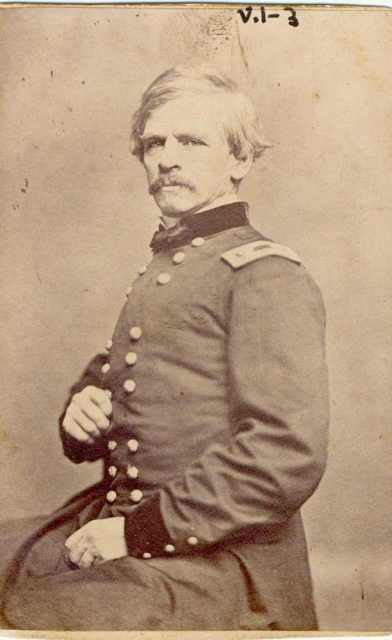
Written on verso: Banks, Nathaniel Prentiss, Maj.-gen. U.S.A., Written on verso: Banks, Nathaniel Prentiss, Maj.-Gen. U.S.A., 1816-1894, Photographer stamp on verso: B. Moses, Corner Canal & Camp Sts., New Orleans, LA.
Sitting, torso length portrait, in uniform. Nathaniel Prentiss Banks (1816-1894) Of the 14 Union officers who received the Thanks of Congress during the Civil War, Nathaniel P. Banks was the least entitled. Serving under five different party labels during his political career, he rose from a childhood job in a cotton mill in his native Massachusetts-which earned him the nickname "Bobbin Boy"-to become speaker of the state legislature's lower house, U.S. congressman and just before the war, governor. As a political appointee, he was named a major general of volunteers. His field career was rather dismal but his appointment served its purpose in rallying support for the war effort. His assignments included: major general, usv (May 16, 1861); commanding division, Department of Annapolis (ca. May - June 11, 1861); commanding the department (June 11 - July 19,1861); commanding Department of the Shenandoah (July 25 - August 17, 1861); commanding division, Military District of the Potomac (August 17 - October 3, 1861); commanding division, Army of the Potomac (October 3,1861 - March 13, 1862); commanding 5th Corps, Army of the Potomac (March 13 - April 4, 1862); again commanding Department of the Shenandoah (April 4 - June 26, 1862); commanding 2nd Corps, Army of Virginia (June 26 - September 4, 1862); commanding Military District of Washington, Army of the Potomac (September 7 - October 27, 1862); commanding 19th Corps, Department of the Gulf (December 16, 1862 - August 20, 1863); commanding the department (December 17, 1862-September 23, 1864 and April 22 - June 3, 1865). With no prior military experience, he was in divisional and departmental command near Washington early in the war. In the Shenandoah Valley he was routed by Stonewall Jackson and due to his tremendous loss of supplies was dubbed "Commissary Banks" by the Confederates. As part of Pope's army, he was again defeated at Cedar Mountain by Jackson and was at 2nd Bull Run. After a brief stint in the capital's defenses he went to New Orleans to replace Benjamin F. Butler. His operations against Port Hudson met with several bloody repulses but the place eventually fell after the surrender of Vicksburg made it untenable. For obvious political reasons, Congress awarded a resolution of thanks to one of its former members. Remaining in the Gulf area, he led the dismal Red River Campaign of 1864 and was then for a time without a command. With hostilities virtually over, be was returned to command but was mustered out on August 24, 1865. Continuing his political career, until 1890, he served in Congress, the state senate, and as a U.S. Marshal. Congress awarded him a $1,200 annual pension. (Harrington, Fred Harvey, Fighting Politician: Major General N. P. Banks) Source: "Who Was Who In The Civil War" by Stewart Sifakis
NEW YORK - NEW YORK - UNITED STATES - Editor/Publisher; HUDSON RIVER - WEST POINT - NEW YORK - UNITED STATES - Related Place
SHORT DESCRIPTION: Black and white book illustration titled 'View of the Hudson From the Vicinity of West Point.' Engraved by Littell and published by DeWolfe, Fiske & Company in Boston. The image shows a view looking down the Hudson at sunset. Many sailing boats and a steamboat, possibly the Garrison ferry, are on the river. The river is bordered by steep highlands. In the foreground a man and two women stand on a plain with their backs to the viewer. A stone bridge or walkway is visible at the lower left corner. At the left center there are some buildings on an open plain near the water, but the main structures of the school are not visible. NOTES: The image is page 13 of 'America Illustrated' (1883 edition). The first edition of this work was published in 1874, printed by The Arundel Print in New York and copyrighted by John D. Williams, the editor. In 1877 the publisher is identified as J. David Williams, at 38 New Street in New York. In 1879 the publisher is The New York Printing & Publishing Company. In 1883 the book was published by DeWolfe, Fiske & Company in Boston. Another 1883 edition was published by the Manhattan Printing and Publishing Company, New York. It also matches 'View from West Point (Hudson River)'. Artist/engraver/cartographer: W.H. Bartlett. Provenance: "American Scenery, or land, lake, and river illustrations of a transatlantic nature", from drawings by W.H. Bartlett, by N.P. Willis, Esq; George Virtue & Co, London, 1837. NOTES: The accompanying text on pages 12 and 14 reads: THE HUDSON RIVER AT WEST POINT. SINCE the time when Hendrick Hudson first sailed up the broad stream that bears his name, it has been a river of romance. The graceful prose of Irving has bestowed fame upon the Headless Horseman and the sleepy good-for-naught Rip Van Winkle, and many poetic recollections cluster about the quiet waters and picturesque banks. The river flows through landscapes of varied beauty, and on either side, as far as the eye can reach, the dark outlines of the Kaatskills and Highlands loom up. The bosom of the stream is dotted with the white sails of yachts and pleasure-boats, and its silence is often broken by the steady paddle-stroke of the stately steamboats that ply between the towns and cities on its shores. Our artist has taken as his subject for illustration the most beautiful and historically the most interesting portion of the river - West Point in the Highlands . The history of the spot on which the famous military academy stands is very romantic. Its natural strength made it a valuable site for a fortress, and the Continental Congress ordered the erection of Fort Putnam at a point 598 feet above the level of the river, commanding a view of the surrounding country for many miles. An approach from the Hadson was made well nigh impossible by an almost perpendicular wall of rock, while on the western and south-western side the steep hills formed a strong barrier. A small force could fold the position for a long tone against an enemy much superior. Above the fort, on a higher plateau, Fort Clinton and the other fortifications were built, forming altogether one of the most formidable strongholds in the world. That this important point came near being treacherously surrendered to the British in 1780, is a familiar fact to readers of American history. It was in command of Benedict Arnold, a man whose dissipation had plunged him deeply into debt, and who was ready to betray his trust for the double purpose of replenishing his purse and gratifying his private revenge. It is well known how nearly he succeeded, and how finally he failed. Major André, whom he was to meet to perfect the arrangements for the delivery of the fortress, was captured by three American soldiers, and the plot was discovered . Washington was to have made a visit of inspection to Fort Putnam and the other redoubts on this side the river, only two or three hours before his discovery of the treason of Arnold, at that moment as he supposed in command at West Point. The commander-in-chief was expected to arrive the evening before, and had he done so, Arnold would probably never have escaped. Having accidentally met the French minister, M. de Lucerne, at Fishkill, however (eight miles above), he was induced to pass the night there for the purpose of some conference, and set off early in the morning on horseback, sending on a messenger to Mrs. Arnold that himself and suite would be with her to breakfast. Arriving opposite West Point, near a small redoubt called Fort Constitution, Washington turned his horse from the road. Lafayette, who was then in his suite, called out, General, you are going in the wrong direction, you know Mrs. Arnold is waiting breakfast for us." "Ah," answered Washington, "I know you young men are all in love with Mrs. Arnold, and wish to get where she is as soon as possible. Go and take your breakfast with her, and tell her not to wait for me: I must ride down and examine the redoubts on this side the river." Two of the aides rode on, found breakfast waiting, and sat down at once with General Arnold and his family. While they were at table, a messenger came in with a letter for Arnold, which announced the capture of André, and the failure and betrayal, of course, of the whole conspiracy. Showing little or no emotion, though his life hung upon a thread, he merely said to one of his aides that his presence was required at West Point; and, leaving word for General Washington that he was called over the river, but would return immediately, he ordered a horse and sent for Mrs. Arnold to her chamber. He then informed her abruptly that they must part, possibly forever, and that his life depended on his reaching the enemy's lines without delay. Struck with horror at this intelligence, she swooned and fell senseless. In that state he left her, hurried down stairs, mounted a horse belonging to one of his aides that stood saddled at the door, and rode with all speed to the bank of the river. A boat with six men was in waiting; and, pretending that he was going with a flag of truce, he pulled down the stream, and arrived safe on board the Vulture sloop-of-war, lying some miles below. André was carried to headquarters, and, after a military trial, was executed, notwithstanding the strenuous efforts of the British authorities to save him. Arnold served for a while in the enemy's army. At the close of the war he went to Europe, where he died in obscurity, shunned by those to whom he had so basely sold his honor. The national military academy was established by Act of Congress in 1802. It is supported by the Government, and the cadets are under no expense for tuition or maintenance; but they are required to serve in the regular army for a term of years after graduation. The appointments are made by Congressmen, and the candidates for admission must be between the ages of sixteen and twenty-one. The course of study, which is full and thorough in all that relates to a military education, requires five years for completion. The academy buildings are erected on a plain nearly two hundred feet above the Hudson, and cover an area a mile in circuit. In addition, there is ample space for the practice of gunnery, and the necessary military evolutions. The impression that cadets studied at West Point as a stepping-stone to some other profession seems to have obtained credence abroad. How erroneous was this opinion may be seen from the remarks of a distinguished European critic who has recently enquired into the subject, and who says: "The point which above all others must strike an observer is the extremely stern military spirit which pervades the whole discipline and teaching. The course is not only longer than at European colleges maintained for similar objects, but is probably more strict and exacting than that of any on the other side of the Atlantic." For many years West Point was considered a useless expense by the people, and newly elected Representatives were wont to make the system of educating what they called "military snobs," the subject of their maiden speeches in the House; but the war with Mexico, and especially the war of the Rebellion, gave ample testimony of its value. Gens. Scott, Grant, Sherman, Sheridan, Mitchell, and many other prominent Union generals graduated there, and the rebel leaders Lee, Pemberton, Stonewall Jackson, and Johnson, also received from the National Government the military knowledge that enabled them to conduct their armies so well.

 P0001.016-02-APP01.048
 MS0228-182
 Full-size image
 Full-size image
 MS0003 - 002.2109-03614
 Full-size image